The Great Unbundling: How AI Agents Are Rewiring Travel Distribution
AI agents are unbundling the OTA model: discovery moves to assistants while fulfillment stays behind. What the data says, and what airlines, hotels and travel operators should do now.
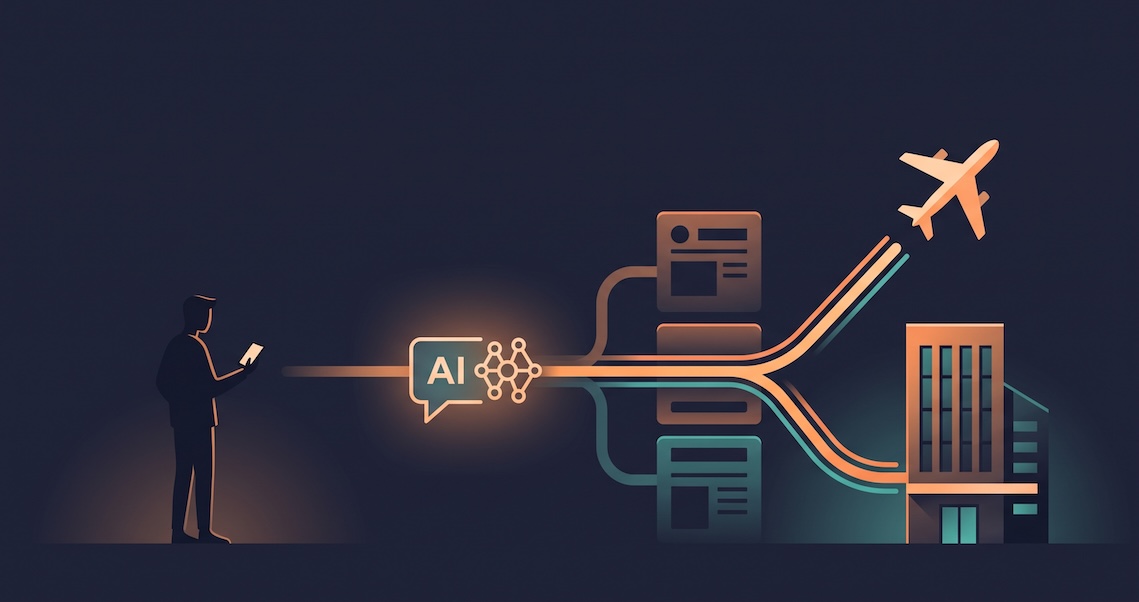
- OTA dominance was built on aggregation plus paid-search mastery: Booking Holdings and Expedia Group together processed over $305 billion in gross bookings in 2025, per their annual filings.
- AI assistants are becoming the first touchpoint of trip planning: Adobe Analytics measured generative AI traffic to US travel sites up 3,500% year over year in July 2025, with the conversion gap versus other channels collapsing from 86% to 14% by March 2026.
- The near-term effect on OTAs is margin squeeze, not extinction: they will pay a new toll to AI platforms on top of the roughly $20 billion the big four already spend annually on sales and marketing, per BTIG.
- Airlines and hotels have their best disintermediation window in 20 years, if they combine NDC-based retailing with direct conversational channels.
- In emerging markets, that direct channel already exists at scale: WhatsApp, with more than 3 billion monthly active users.
AI agents are inserting themselves between travelers and the online travel agencies (OTAs) that have controlled distribution for two decades. They will not kill the OTAs. They will do something more interesting: unbundle the OTA value proposition into pieces, and force every player in the roughly $1.67 trillion global travel market, as sized by Phocuswright's Travel Forward 2026 report, to renegotiate where demand is captured and who pays for it. FCB.ai builds conversational AI for airlines and travel operators, so we watch this shift operationally, not theoretically. This analysis lays out the economics that built OTA dominance, the specific ways AI agents threaten them, why suppliers finally have leverage, and what travel operators should do while the window is open.
How OTAs won the last era of travel distribution
Online travel agencies won by solving two problems at once: fragmentation for travelers and customer acquisition for suppliers. A traveler got one interface to compare thousands of hotels and fares. A hotel in Lisbon or an airline in Fort-de-France got access to global demand it could never afford to acquire alone. The toll for that matchmaking is the take rate, the share of each booking the intermediary keeps.
The scale this produced is easy to underestimate. Booking Holdings reported $186.1 billion in gross bookings and $26.9 billion in revenue for 2025 in its annual results, a blended take rate of roughly 14.5%. Expedia Group reported $119.6 billion in gross bookings and $14.7 billion in revenue for the same year, roughly 12.3%. Skift Research sized the global OTA market at $94 billion in revenue for 2024, projected to reach $107 billion by 2026.
Two moats protected that position. The first is the paid-search machine: Booking Holdings alone spent $8.2 billion on marketing in 2025, per its earnings release, most of it historically flowing to Google. Suppliers could not outbid that. The second is the billboard effect, the long-observed pattern where OTA listings drive direct bookings anyway, which kept suppliers dependent on OTA visibility even for the demand they served themselves. Both moats share one assumption: that travel discovery starts with a search box and a list of blue links. That assumption is now breaking.
Why AI agents threaten the OTA model
The threat is not that a chatbot books a flight. The threat is that the traveler's first question moves from Google to an AI assistant, and the assistant, not the auction, decides which three options the traveler ever sees. Discovery is where OTA economics live. Whoever owns discovery taxes everyone downstream.
The behavioral shift is measurable. Adobe Analytics recorded a 3,500% year-over-year increase in generative AI traffic to US travel sites in July 2025, and Adobe's survey found 29% of US consumers had already used AI to plan trips. Phocuswright's February 2026 survey put AI usage among US travelers at 56% for planning, booking or in-destination help, up from 43% a year earlier. Early AI traffic converted poorly, which let incumbents dismiss it. That excuse is gone: Adobe's Q2 2026 AI traffic report shows the travel conversion gap between AI-referred and other visitors narrowing from 86% in October 2024 to 14% by March 2026.
The platforms are building on that behavior. At OpenAI's DevDay on October 6, 2025, Booking.com and Expedia launched as the first travel apps inside ChatGPT, letting users search live inventory conversationally, with payment completing on the OTA's own site. In November 2025, Google announced agentic flight and hotel booking for AI Mode with Booking.com, Expedia, Marriott, IHG, Choice Hotels and Wyndham as partners; Booking Holdings and Expedia shares fell 4 to 7% on the announcement, per Skift, even though Google insisted it has no intention of becoming an OTA or the merchant of record.
Note what the OTAs are doing in both cases: paying to be present inside someone else's interface. That is the strategic demotion. When ChatGPT or Gemini owns the conversation, the OTA becomes a fulfillment API, one of several the agent can call. Its brand, its merchandising, its cross-sell, the entire front-end where its margin is justified, gets compressed into a card in someone else's chat. Booking Holdings' own 2025 10-K now lists AI-enabled direct channels among its competitive risks. The most-cited defense, that agents lack booking capability, is weakening on a monthly cadence, and the OTAs' rush to integrate confirms they believe it.
The airline and hotel counter-offensive: NDC, loyalty and AI-ready inventory
Suppliers have tried to route around OTAs for 20 years; AI agents are the first technology that changes the math. The airline industry's main instrument is NDC, the New Distribution Capability, an API standard IATA launched with Resolution 787 in October 2012 to replace legacy EDIFACT messaging and let airlines control their own offers in any channel. Progress has been slow: a 2025 Accelya report found that while 72% of airlines recognize the importance of the broader Offers and Orders transformation, only 27% have begun transformation programs. But where it works, it works: Accelya's Barbara Moreno reports carriers moving from ancillary attachment rates of 5 to 8% on EDIFACT to as much as 35% on NDC channels, and Finnair created the industry's first native Order in May 2025. Roland Berger, citing industry estimates, puts the value of modern retailing at up to $45 billion globally by 2030.
Here is why AI accelerates this rather than just complicating it. An AI agent shopping on a traveler's behalf does not care about brand placement in a search results page. It cares about machine-readable, real-time, personalized offers it can query through an API. That is precisely what NDC produces and what screen-scraped OTA inventory is not. For the first time, the supplier's direct pipe can be technically superior to the intermediary's aggregated one. Add loyalty: the airline knows the traveler's history, status and preferences, data an agent needs and an OTA guards. A supplier that exposes rich offers plus loyalty context to agent ecosystems is suddenly the path of least resistance, not the detour.
The unresolved question is who the agent trusts by default, and that fight, not booking technology, will decide how much traffic actually moves.
Where conversational channels fit in the new stack
While Silicon Valley debates agent protocols, a direct conversational channel already operates at scale: messaging. WhatsApp passed 3 billion monthly active users in 2025, per Meta's Q1 2025 earnings, and a Meta-commissioned Kantar survey of 11,056 consumers across 22 markets found 73.3% prefer messaging when communicating with a business. Meta reported WhatsApp paid messaging crossing a $2 billion annualized revenue run rate by late 2025. In most of Africa, Latin America and Southeast Asia, WhatsApp is not one channel among many; it is where the customer already is, on any device, on any bandwidth.
This matters to the unbundling thesis because a conversational AI on WhatsApp is a supplier-owned agent. The airline or hotel deploys the assistant, holds the customer relationship, keeps the data and pays no take rate on the booking. It collapses discovery, service and rebooking into one thread the traveler never leaves. FCB.ai operates WhatsApp customer journeys for airlines including Air Caraïbes, French Bee and Air Austral, and the operational lesson from these travel deployments (fcb.ai/…/travel) is consistent: the highest-value conversations are not first bookings, they are disruption handling, rebooking and ancillary sales, exactly the interactions OTAs monetize worst and abandon fastest. For carriers serving francophone and African markets, where WhatsApp penetration is dominant, the direct conversational channel is not a hedge against AI platforms; it is the near-term version of the same shift, available today without waiting for Google's booking flow to launch.
The strategic point generalizes: in the agentic era, "direct" stops meaning "our website" and starts meaning "any AI-mediated surface where we own the relationship." Messaging is the most mature of those surfaces.
What won't change: the honest case for OTAs
A credible analysis has to steelman the incumbents, and the case is real. Investment bank BTIG concluded in mid-2026 that AI is more likely to evolve into a customer acquisition channel for OTAs than a disintermediation event, noting their decades of behavioral data, millions of connected properties and marketing budgets exceeding $20 billion annually across the big four. Aggregation itself remains genuinely valuable: an agent still needs someone to have wired up two million hotels, normalized their content and guaranteed the reservation, and rebuilding that supplier network is a decade of unglamorous work no AI lab wants.
Events have partly vindicated this view. In March 2026, OpenAI retreated from native ChatGPT checkout to focus on discovery, routing transactions back to merchants; Expedia shares rose 12% and Booking Holdings 8% on the news, per Skift. Google's agentic hotel and flight booking, announced in November 2025, had still not broadly launched by mid-2026. Trust, payments liability, fraud, servicing and regulation are exactly the boring capabilities OTAs have and agents lack. The realistic scenario is therefore not OTA extinction. It is OTAs surviving as fulfillment and settlement infrastructure while ceding discovery, paying platform tolls on top of Google tolls, and watching take rates compress. Survival and dominance are different outcomes, and only one of them supports a 14% blended take rate.
What travel operators should do now
The window between "AI owns discovery" and "defaults harden" is the entire game, and it is open now. Four moves follow directly from the evidence above.
First, make inventory agent-readable. NDC or equivalent APIs, structured content, machine-verifiable pricing. An agent cannot recommend what it cannot query, and Phocuswright's 2026 outlook is blunt that the new goal is being cited in AI answers, not ranking in links.
Second, measure AI-sourced demand separately. Adobe's data shows this traffic converting near parity; if your analytics still bucket it as "referral," you are managing the shift blind.
Third, open a direct conversational channel where your customers already are, and staff it with AI that can transact and service, not a FAQ bot. For operators in francophone Europe, Africa and island markets, that channel is WhatsApp, and the travel deployments FCB.ai runs with Air Caraïbes, French Bee and Air Austral show the model working across booking support, disruption and ancillaries. The FCB.ai platform (fcb.ai/product) exists for exactly this layer of the stack.
Fourth, treat loyalty data as agent fuel. The supplier that lets a traveler's preferred agent act on status, preferences and history will win the default slot that OTAs are currently paying to occupy.
Related reading: AI travel booking agents in 2026, at fcb.ai/…/ai-travel-booking-agents-2026
FCB.ai deploys conversational AI on WhatsApp for airlines, insurers and financial institutions across Africa and francophone Europe. To see how travel operators are using it, visit fcb.ai/…/travel
References
- Phocuswright, "Travel Forward: Data, Insights and Trends for 2026", December 2025. phocuswright.com/…/Travel-Forward-Data-Insights-and-Trend…
- PhocusWire, "From $1.6T to $1.8T: How global travel will grow, shift, go digital by 2027", October 2025. phocuswire.com/global-travel-next-chapter-phocuswright-re…
- Booking Holdings, Q4 and Full Year 2025 Results (8-K), February 2026. sec.gov/…/q4-25bkngearningsrelease.htm
- Booking Holdings, 2025 Form 10-K, February 2026. stocktitan.net/…/10-k-booking-holdings-inc-files-annual-r…
- Expedia Group, Q4 and Full Year 2025 Results, 12 February 2026. ir.expediagroup.com/…/default.aspx
- Skift Research, "Global Online Travel Sector Market Estimates 2025". research.skift.com/…/global-online-travel-sector-market-e…
- Skift, "ChatGPT Travel Apps Are Now a Thing, Starting with Booking.com and Expedia", 6 October 2025. skift.com/…/expedia-booking-chatgpt-apps-openai
- PhocusWire, "ChatGPT brings apps into chat, starting with Expedia and Booking.com", 7 October 2025. phocuswire.com/openai-chatgpt-apps-expedia-booking-tripad…
- Skift, "ChatGPT Bails on Transactions", 5 March 2026. skift.com/…/openai-chatgpt-checkout-walkback
- Skift, "Google Clarifies Its Agentic AI Booking Plans: 'No Intention of Becoming an OTA'", 20 November 2025. skift.com/…/google-agentic-ai-travel-booking-no-intention…
- PhocusWire, "Hotel, flight bookings coming to Google's AI Mode", November 2025. phocuswire.com/google-agentic-travel-booking-ai
- Adobe, "Consumers embrace generative AI for trip planning", 3 September 2025. business.adobe.com/…/consumers-embrace-generative-ai-for-…
- Adobe Digital Insights, "Quarterly AI Traffic Report", April 2026. business.adobe.com/…/q2-2026-adi-ai-sourced-traffic-insig…
- PhocusWire, "AI risk to OTAs is margin squeeze, not disintermediation" (citing BTIG and Phocuswright), July 2026. phocuswire.com/…/ota-ai-margin-pressure-disintermediation
- IATA, "Distribution with Offers and Orders (NDC)". iata.org/…/ndc
- Roland Berger, "Airline order and offer management" (citing Accelya 2025), 2025. rolandberger.com/…/Airline-order-and-offer-management.html
- AltexSoft, "NDC Challenges for Airlines", August 2025. altexsoft.com/…/ndc-challenges-airlines
- AltexSoft, "ONE Order by IATA: A Look at Progress and Roadblocks", September 2025. altexsoft.com/…/iata-one-order-for-the-airlines
- Meta / Kantar, "The State of Business Messaging", 2025. business.whatsapp.com/…/state-of-business-messaging
- Meta earnings data via WhatsApp statistics roundups (Kira Agency; WizMessage), 2025-2026. kiraco.org/…/whatsapp-business-ai-statistics-2026
Frequently asked questions
6 answers, all expandedWill AI agents replace online travel agencies?
Not in the near term. AI agents are replacing the discovery function OTAs monopolized, while OTAs remain strong in fulfillment, payments and supplier aggregation. The evidenced outcome is margin compression and strategic demotion: OTAs increasingly operate inside AI platforms such as ChatGPT and Google AI Mode rather than owning the customer interface. BTIG and Phocuswright analysis through 2026 supports margin squeeze over outright disintermediation.
How are airlines and hotels using AI to divert traffic from OTAs?
Three ways: exposing NDC-based offers that AI agents can query directly, using loyalty data to personalize direct offers agents cannot get elsewhere, and deploying their own conversational AI on channels like WhatsApp so discovery, booking and servicing happen in a supplier-owned thread. Airlines on NDC channels have reported ancillary attachment rates several times higher than legacy channels, per Accelya.
Is WhatsApp becoming a travel booking channel?
Yes, especially outside North America. WhatsApp passed 3 billion monthly active users in 2025, Meta reports paid business messaging above a $2 billion annualized run rate, and 73.3% of consumers across 22 markets say they prefer messaging with businesses, per a Meta-commissioned Kantar study. Airlines including Air Caraïbes, French Bee and Air Austral already run customer journeys on WhatsApp through conversational AI platforms.
What is travel distribution disintermediation?
Disintermediation is when a travel supplier, an airline or hotel, sells to the traveler without an intermediary such as an OTA or global distribution system, avoiding the commission or take rate the intermediary charges. In the AI era the definition is widening: the key question is no longer just who processes the booking, but which AI system controls the traveler's consideration set before booking begins.
Will OTAs still be relevant in an AI-driven travel world?
Yes, but with a changed role and thinner economics. Their supplier networks, settlement infrastructure and service guarantees remain hard to replicate, which is why OpenAI and Google both partnered with Booking.com and Expedia rather than bypassing them. Relevance as infrastructure, however, does not protect the double-digit take rates that were built on owning discovery.
How big is the shift to AI-assisted travel planning so far?
Large and accelerating. Adobe Analytics measured generative AI traffic to US travel sites up 3,500% year over year in July 2025, Phocuswright found 56% of US travelers used AI for travel in the prior 12 months by early 2026, and Adobe's Q2 2026 report shows AI-referred travel visitors now converting within 14% of other channels.