WhatsApp Debt Collection: How Conversational AI Recovers More, For Less
Phone-based collections is losing reach while costs and compliance pressure rise. Here is how conversational AI on WhatsApp works each stage of the arrears cycle, what the evidence shows, and how to keep it compliant across the US, UK, South Africa and francophone Africa.
- Outbound calling is structurally impaired: 62% of collectors surveyed by ACA International reported falling right-party contact rates, with 78% experiencing call blocking (survey reported January 2024).
- Consumers prefer messaging: 73.3% would rather message a business than use legacy channels, according to Meta and Kantar's 2025 survey of 11,056 adults in 22 markets.
- McKinsey (June 2024) reports that advanced gen AI in collections can cut operating expenses by up to 40% and lift recoveries by roughly 10%.
- WhatsApp is not exempt from collections law. Reg F, FCA CONC 7, the NCA and POPIA all apply, and a well-built AI agent is easier to keep compliant than a call floor.
Traditional collections is losing the contact battle. Phone-based outreach is being blocked, mislabelled as spam and ignored, while cost-to-collect rises and regulators tighten the rules on frequency, timing and tone. WhatsApp debt collection, run by conversational AI rather than a dialler, changes the economics: it reaches borrowers on the channel they already use, holds a two-way conversation, and records every step in one thread.
This article covers what WhatsApp debt collection is, how an AI agent works each stage of the collections lifecycle, what the evidence says about results, and how to keep it compliant across the US, UK, South Africa and francophone Africa.
Why traditional debt collection is breaking
The core problem is reach. Collections still relies on outbound calls, yet a growing share of those calls never connect with the borrower. In a member survey by ACA International, the US collections trade body, 62% of respondents reported a decrease in right-party contacts, 78% experienced call blocking and 74% saw their calls mislabelled as spam or scam (as reported by TrueAccord, January 2024). ACA's own policy position, updated in May 2026, states that carrier analytics engines "frequently mislabel or block legitimate business calls", cutting consumers off from time-sensitive financial information.
Reach was declining before spam filtering matured. McKinsey noted in 2019 that many issuers had already cut calling frequency to avoid harassment complaints, and still could not lift contact rates. The result is a call floor that dials more, connects less, and costs the same: every unanswered dial still consumes agent time, dialler licences and compliance overhead.
Regulation compounds it. Under the US CFPB's Regulation F (12 CFR Part 1006, in force since November 2021), more than seven calls in seven days about one debt is presumed harassment, and calls before 8am or after 9pm local time are presumed inconvenient. In the UK, FCA CONC 7 requires forbearance, negotiation of reasonable repayment proposals and particular care with vulnerable customers under the Consumer Duty. These are the right rules. They also make voice-first collections harder to run at scale.
What is WhatsApp debt collection?
WhatsApp debt collection is the use of the WhatsApp Business Platform, usually with an AI agent behind it, to remind, engage, negotiate with and take payment from borrowers in arrears. Instead of a call from an unknown number, the borrower receives a message in an app they open every day, can reply in their own time, and can complete a promise to pay or a payment inside the same thread.
Three properties make the channel different from SMS, email or voice.
Reach. WhatsApp passed 3 billion monthly active users, Meta reported on its Q1 2025 earnings call. In the markets where FCB.ai operates, from South Africa and Namibia to Morocco and France, it is the default messaging layer.
Preference. Meta's State of Business Messaging report, based on a Kantar survey of 11,056 adults across 22 markets (April to September 2025), found that 73.3% of consumers prefer messaging when communicating with a business, 69% say waiting on hold is a waste of time, and 74.6% trust a business more when they can exchange messages with it. For a borrower in arrears, often embarrassed and avoiding calls, that preference is decisive.
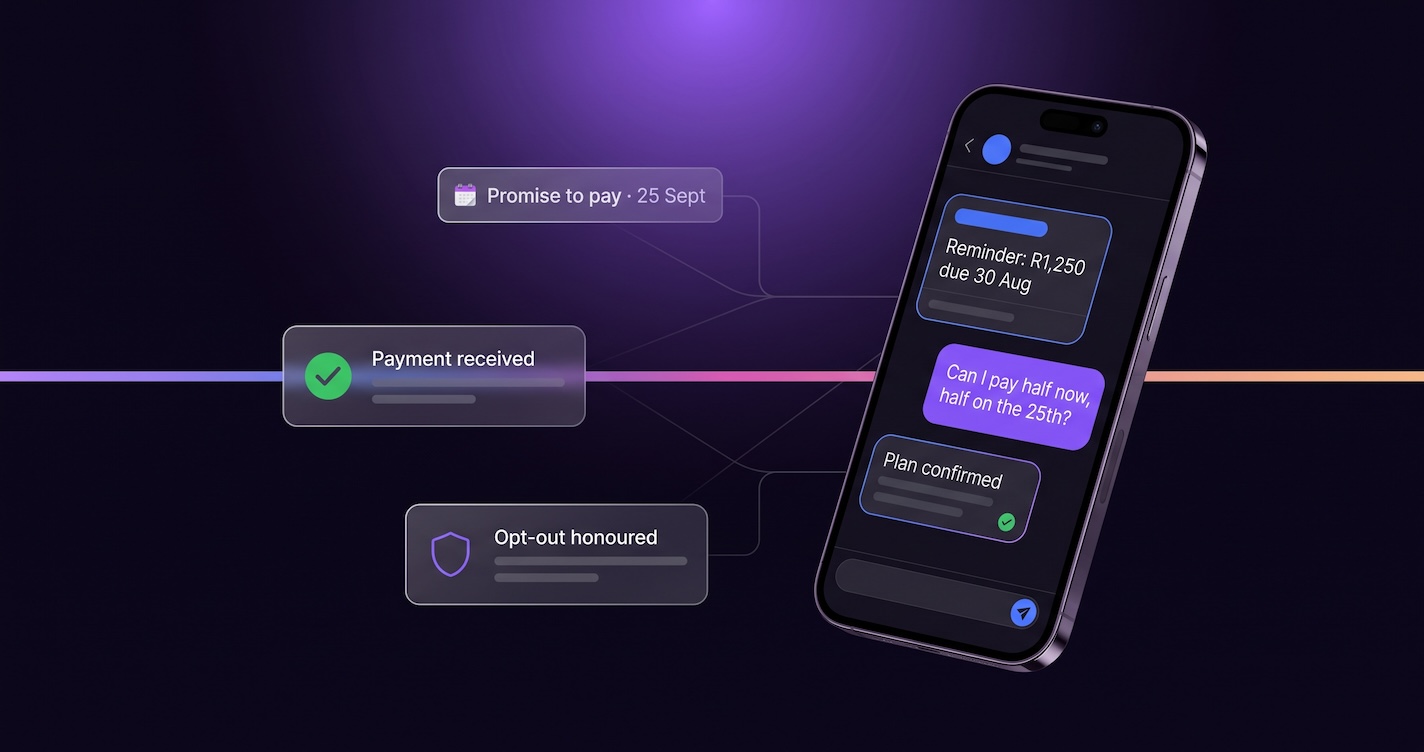
Persistent, two-way thread. A WhatsApp conversation is a single, timestamped record with delivery and read receipts. Every reminder, offer, acceptance and payment confirmation sits in one place. That thread is the audit trail, and it is what makes negotiation possible: the borrower can say "I can pay half on the 25th" and get an answer immediately.
A note on the widely quoted 98% open rate: it circulates across vendor blogs with no traceable primary source, and read receipts are not measurable when users disable them. We do not use it.
How conversational AI handles the collections workflow
A conversational AI agent for debt collection is not a broadcast tool. It works each delinquency bucket differently and knows when to hand over. FCB.ai's WhatsApp debt collection platform, described on our AI debt collection page, is built around this bucket-stage logic.
Pre-due reminders (day -5 to 0)
The AI sends an approved template a few days before the due date: amount, date, a one-tap option to confirm or flag a problem. Borrowers who reply "can't this month" go straight into a payment-plan flow rather than into arrears. This is the cheapest money a collections team will ever recover. McKinsey's digital-collections research (2021) found that digital-first customers contacted digitally make 12% more payments than those contacted through traditional channels, and that SMS or WhatsApp nudges are less intrusive and cheaper than voice calls where local rules permit.
Early-stage arrears (1 to 30 days)
The agent confirms identity, states the balance and offers structured choices: pay now, promise to pay by a date, or explain a difficulty. Every promise to pay is stored with a date and amount, then followed up automatically the day before and the day after. Missed promises trigger a different script than first contact. Because it is a conversation, the borrower can dispute the balance or ask for a statement and receive it in-thread.
Structured negotiation (30 to 60 days)
The agent operates within pre-approved treatment rules: minimum instalment, maximum term, settlement discount bands, hardship criteria. It can offer a plan, counter within limits, and confirm the agreement in writing. It cannot improvise outside policy, which is what regulators and internal audit want. Requests outside the rules, or any disclosure of vulnerability, are flagged to a human.
Late-stage handoff (60 days plus)
Late-stage and legal actions stay with people. The AI summarises the conversation history, promises made and broken, and the borrower's stated circumstances, so the collector or attorney does not start from zero. In South Africa, this is where the National Credit Act section 129 notice must precede legal action, and the WhatsApp thread evidences prior engagement.
Skip tracing and re-engagement
When phone numbers die, a WhatsApp number often survives, because people port and keep them. Template delivery status tells you immediately whether a number is live; undelivered contacts go to a data-refresh queue instead of consuming dialler capacity.
Across all five stages, McKinsey's June 2024 analysis of gen AI in credit customer assistance is the most useful external benchmark: up to a 40% reduction in operational expenses, around a 10% improvement in recoveries, and up to a 30% rise in customer satisfaction scores. In one bank implementation, an agent copilot was projected to lift recoveries by 6% and agent productivity by up to 14%.
Related reading: Revolutionising debt collection: how AI is transforming the South African industry.
The benefits of AI in debt collection, quantified
Higher effective contact rate. The gain is not only that a message is seen more often than a call is answered; it is that a message can be acted on asynchronously. TrueAccord, a US digital-first collector, reports that 98% of the delinquent consumers it services resolve their debt without any human interaction, and that 29% of online payments are made outside the hours in which FDCPA permits calls (TrueAccord, October 2024).
Lower cost-to-collect. McKinsey's up-to-40% opex figure is the headline. The mechanics: the AI absorbs high-volume, low-complexity contacts (reminders, balance queries, promise-to-pay logging, plan set-up), so human collectors spend their hours on accounts that need judgement. A utility cited in the same McKinsey article aimed to move more than 45% of inbound volume to a virtual agent at a fraction of the cost of human representatives.
24/7 availability. Under Reg F a collector cannot call at 10pm; a borrower can open a WhatsApp thread at 10pm and set up a plan. The channel turns inconvenient-time constraints from a lost contact into self-service.
Consistent, compliant messaging. Every message is an approved template or a policy-bounded response. Tone, disclosures and offers are identical across ten thousand conversations, and every one is logged.
Better borrower experience. Meta and Kantar's 2025 survey found 67.7% of consumers agree that a response from an AI chatbot is helpful. McKinsey observes that many customers in arrears prefer to negotiate with a machine rather than explain financial difficulty to a person. Removing the shame factor is what gets the borrower to reply.
Staying compliant when AI runs WhatsApp debt collection
WhatsApp is a channel, not a loophole. The same law applies, and in most cases the platform makes compliance easier to evidence.
United States, FDCPA and Regulation F (12 CFR 1006). Reg F permits electronic communication, but every electronic message must carry a clear, free and simple opt-out, and opt-outs must be honoured. The 7-in-7 presumption applies to calls, and the CFPB looks at the cumulative effect of all channels. Text messaging needs prior consent given directly to the collector, with reassigned-number checks or renewed consent every 60 days. Contact before 8am or after 9pm local time is presumed inconvenient. An AI agent enforces all of this mechanically: send windows by time zone, frequency caps per debt, an opt-out keyword on every template.
United Kingdom, FCA CONC 7 and the Consumer Duty. Firms must treat customers in or approaching arrears with forbearance, must not refuse to negotiate with a customer developing a repayment plan, must signpost free debt advice, and must take particular care with vulnerable customers. A policy-bounded AI negotiator, with vulnerability triggers that escalate to a human, is a direct implementation of these obligations rather than a workaround.
South Africa, NCA, Debt Collectors Act and POPIA. The National Credit Act 34 of 2005 requires a section 129 notice before legal action and caps interest and fees under the in duplum rule. Registered collectors are bound by the Council for Debt Collectors' code of conduct, which prohibits threats, intimidation and communications that simulate legal process. POPIA requires that personal information is processed lawfully, for a specific purpose and no more than necessary. In practice: verify identity before disclosing balances, message only the debtor, keep the data minimal, and log the purpose.
Francophone Africa. In the OHADA zone, the revised Uniform Act on simplified recovery procedures and enforcement (AUPSRVE), adopted 17 October 2023 and in force since 16 February 2024, governs judicial recovery and now extends attachment to electronic-money balances such as mobile-money wallets. Amicable recovery by message sits under national consumer and data-protection laws, which generally require a lawful basis, purpose limitation and a right to object. Local counsel should sign off templates in each jurisdiction.
Meta's own rules. The WhatsApp Business Messaging Policy requires opt-in before a business initiates a conversation, approved templates outside the 24-hour customer service window, respect for every opt-out, and no misleading or spam content. Meta enforces this through quality ratings that throttle senders with high block or report rates. A collections programme that ignores this loses the channel before it loses a regulatory case.
AI can be more compliant than a call floor for three reasons: guardrails are enforced in code, not trained into people; every interaction is logged verbatim with timestamps and read receipts; and contact windows, frequency and consent state are checked automatically before every send. FCB.ai does not claim regulatory certifications; compliance design is built with each client's legal team and local counsel.
Putting it into practice
FCB.ai runs WhatsApp debt collection workflows in production for retail-credit providers, including TFG (The Foschini Group), on the Meta Cloud API with the bucket-stage logic described above. If you are evaluating the channel, the fastest way to judge it is to see a live conversation on your own treatment rules. See how the platform works, or explore what else we deploy for lenders and insurers on the finance hub.
References
- Meta / WhatsApp for Business, "The State of Business Messaging" (Kantar survey, April to September 2025, 11,056 adults, 22 markets), 2026. whatsappbusiness.com/…/state-of-business-messaging
- McKinsey & Company, "The promise of generative AI for credit customer assistance", 25 June 2024. mckinsey.com/…/the-promise-of-generative-ai-for-credit-cu…
- McKinsey & Company, "Holistic customer assistance through digital-first collections", 21 May 2021. mckinsey.com/…/holistic-customer-assistance-through-digit…
- McKinsey & Company, "Going digital in collections to improve resilience against credit losses", 29 April 2019. mckinsey.com/…/going-digital-in-collections-to-improve-re…
- TrueAccord, "Declining RPC rates, rising consumer complaints" (citing ACA International member survey), 31 January 2024. blog.trueaccord.com/…/declining-rpc-rates-rising-consumer…
- ACA International, "TCPA reform and regulations" (policy position), May 2026. policymakers.acainternational.org/…/tcpa-reform-and-regul…
- TrueAccord, "The TrueAccord difference for a better self-serve consumer experience", October 2024. blog.trueaccord.com/…/the-trueaccord-difference-for-a-bet…
- TechCrunch, "WhatsApp now has more than 3 billion users a month", 1 May 2025. techcrunch.com/…/whatsapp-now-has-more-than-3-billion-use…
- eCFR, 12 CFR Part 1006, Debt Collection Practices (Regulation F). ecfr.gov/…/part-1006
- FCA Handbook, CONC 7, Arrears, default and recovery. handbook.fca.org.uk/…/conc7
- National Credit Act 34 of 2005 (South Africa), sections 129 and 130; commentary in PER 2018(21), SAFLII. saflii.org/…/21.html
- Bredell Ferreira Attorneys, "Debt collection compliance in South Africa", July 2026 (Council for Debt Collectors code, POPIA). bredellferreira.co.za/debt-collection-compliance-in-south…
- Lexbase Afrique-OHADA, "Entrée en vigueur de l'AUPSRVE", 29 February 2024. lexbase.fr/…/105184971-a-la-une-entree-en-vigueur-de-lact…
- WhatsApp Business Messaging Policy, Meta, accessed August 2026. business.whatsapp.com/policy
- Meta for Developers, "Get opt-in for WhatsApp". developers.facebook.com/…/getting-opt-in
Frequently asked questions
6 answers, all expandedIs AI debt collection legal?
Yes, provided the same rules that bind human collectors are followed. Regulation F in the US allows electronic communication with opt-out; FCA CONC 7 governs conduct regardless of channel; South Africa's NCA, Debt Collectors Act and POPIA apply equally. There is no technology exemption. What changes is how compliance is evidenced.
How is WhatsApp debt collection different from SMS?
SMS is one-way and character-limited. WhatsApp is a persistent two-way thread with delivery and read status, documents and interactive buttons, so a borrower can dispute a balance, request a statement or agree a plan in one conversation. Meta also requires opt-in and approved templates, a discipline SMS lacks.
Can AI handle disputes?
Partly. An AI agent can log a dispute, pause collection activity, serve statements or contracts and confirm the dispute in writing. Substantive resolution of a contested balance is escalated to a human with the full history attached. Treating "dispute" as an escalation trigger rather than a script branch is the safe design.
What is the typical contact-rate improvement?
There is no honest single number; it depends on data quality, market and product. Directionally, digital-first customers make 12% more payments when contacted digitally (McKinsey, 2021), and digital-first collectors report most resolutions with no human contact (TrueAccord, 2024). Measure right-party engagement and promise-to-pay conversion by bucket, before and after, on your own book.
How does borrower consent work on WhatsApp?
The business must obtain opt-in before starting a conversation and be able to show it. Opt-in can be collected at origination, in the credit agreement, on the website or in-app, and should name the business and the message types. Every template must offer a simple way to stop. Consent for collections messaging is separate from marketing consent.
Does AI replace human collectors?
No. It removes the volume work: reminders, balance queries, promise-to-pay logging, plan set-up and out-of-hours self-service. Humans handle hardship, vulnerability, disputes, high-balance negotiation and late-stage or legal action, and start each case with a full record instead of a cold call.